
Skip to content
OGB · Sandwich PanelsInsulated Building Envelope

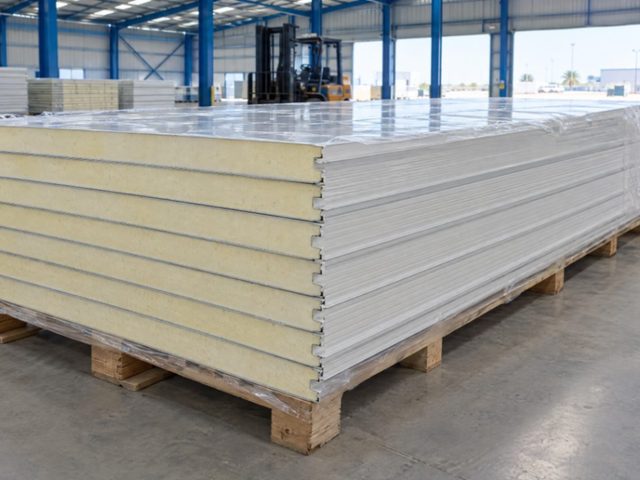
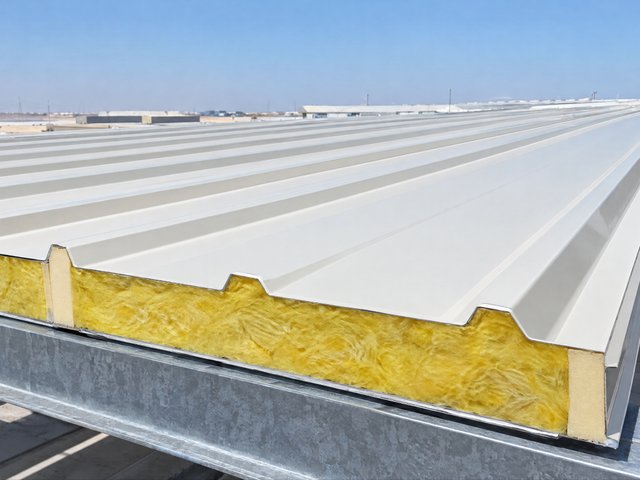
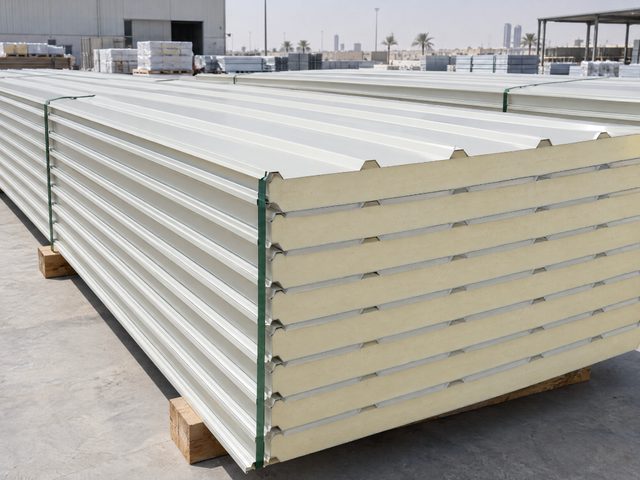
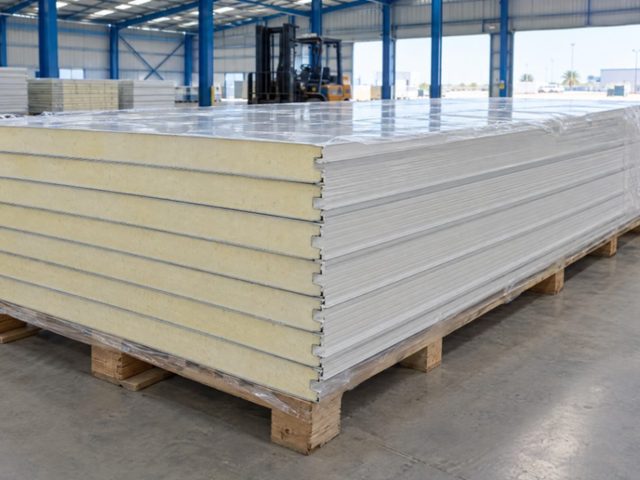
ShownRock wool wall panel: dense stone wool core with fibres running between two pre-painted steel skins, tongue-and-groove joint

Sandwich Panels · By Core Material

Rock Wool Sandwich Panels

Fire-rated mineral wool core panels for walls, roofs and partitions where fire safety and sound control come first.

Group
By Core Material
Market
United Arab Emirates
Supply
Quotation per enquiry

Product overview

Rock Wool Sandwich Panels: overview and uses

A rock wool sandwich panel has a non-combustible mineral (stone) wool core bonded between two pre-painted steel skins. It is the panel chosen where fire resistance matters most, with tested systems rated for 60 to 120 minutes.

The core is made of stone fibres cut into lamellas, with the fibres standing at right angles to the steel skins so the panel stays stiff and bonds well. Stone wool does not burn: the core alone is classed A1 (non-combustible) under EN 13501-1. That is why rock wool panels are specified for fire walls, compartment walls, plant rooms and buildings that insurers or civil defence ask to be fire rated.

It insulates less per millimetre than PU or PIR foam, so a rock wool wall is usually thicker for the same U-value. In return it is denser, absorbs more sound and keeps its strength at high temperature. OGB supplies wall and roof versions; the fire rating depends on the full tested system (panel, joints, fixings and flashings), so the test certificate is confirmed for each project.

Characteristics

Why Rock Wool Panels works in the UAE

Non-combustible core

Stone wool core rated A1 to EN 13501-1; tested panel systems reach 60 – 120 minutes fire resistance.

Dense, quiet, stiff

Core density about 100 – 120 kg/m³ gives sound reduction of around 30 dB and a rigid panel.

Holds up in heat

Mineral fibres keep their shape at high temperature, which suits hot UAE roofs and plant areas.

Build your panel

Choose core, thickness and colour

Pick a combination to see its insulation value, then send it to OGB as a quotation request. Every panel is made to order and cut to your length.

1 · Core
2 · Thickness
3 · Outer colour

Colours shown are the common stock RAL shades; other RAL colours, PVDF coatings and different inner/outer colours are available on request. Screen colours are approximate, so confirm against a physical colour card.

Selection guide

Rock wool vs PU / PIR vs EPS cores

Rock wool vs PU / PIR vs EPS cores
Rock woolPU / PIREPS
Thermal conductivity (W/m·K)≈ 0.040 – 0.045≈ 0.022≈ 0.032 – 0.038
Core reaction to fireA1, non-combustibleCombustible foam (PIR better than PU)Combustible foam
Core density (kg/m³)≈ 100 – 120≈ 38 – 42≈ 15 – 30
Thickness for the same insulationThickestThinnestMiddle
Best forFire walls, plant rooms, acousticAir-conditioned and cold buildingsCabins, sheds, low cost

Typical published values; the panel manufacturer’s declared values and test certificates govern each order.

Where rock wool panels are used, and why

Rock wool panels are chosen when a wall or roof has to keep a fire on one side for a set time. The stone fibres do not burn, so the core does not feed the fire, does not drip and gives off very little smoke. A tested wall can hold back flames and keep the far side cool for 60 or 120 minutes, which gives people time to leave and limits damage.

  1. 01Fire walls and compartment walls: these split a large warehouse or factory into fire zones, so a fire in one zone is contained and the rest of the stock is protected.
  2. 02Power, utilities and plant rooms: substations, generator rooms, transformer bays, battery and UPS rooms, where equipment can overheat and the building must be protected.
  3. 03Storage of combustible goods: furniture, paper, textiles, tyres and chemicals in drums. Insurers often ask for non-combustible walls between storage zones.
  4. 04Kitchens, food production and process areas: hot equipment such as ovens and fryers sits next to the wall panels.
  5. 05Labour accommodation and multi-occupancy buildings: separating walls between rooms and corridors add a margin of fire safety.
  6. 06Noisy spaces: workshops, compressor rooms, generator enclosures and production lines. The dense core cuts sound passing through the wall to around 30 dB.
How to choose the right thickness

Thickness is set by two things: the fire rating you need and the insulation you need. In the UAE heat the insulation requirement usually decides it for air-conditioned spaces, while the fire test decides it for fire walls.

  1. 0150 – 60 mm: internal partitions and enclosures where a basic fire rating is needed.
  2. 0280 – 100 mm: external walls of warehouses and factories; a common choice for 60-minute fire-rated systems.
  3. 03120 – 150 mm: fire walls needing longer ratings, and air-conditioned buildings where the U-value must be lower.
  4. 04200 mm: special cases with long fire ratings or very low U-value targets.

Before you order: what to check

A fire rating belongs to a complete tested system, not to the core alone. Make sure the documents match what will actually be built.

  1. 01Ask for the fire test report and certificate for the exact panel thickness, joint and fixing method being installed.
  2. 02In the UAE, wall and facade materials need Civil Defence acceptance; confirm that the panel system is approved before construction starts.
  3. 03Check the span tables: rock wool panels are heavier than foam panels, so purlin and girt spacing must suit the panel weight and wind load.
  4. 04Use matching fire-rated details at joints, penetrations and openings. A gap or an ordinary sealant at a joint can undo the rating of the whole wall.
  5. 05Keep panels dry and covered on site; mineral wool must not be left exposed to rain at cut ends.

Technical data

Specifications

Share your required size, quantity and finish in the enquiry form and OGB confirms availability in writing.

Enquire about Rock Wool Panels
Rock Wool Sandwich Panels specifications
Core Rock (stone) wool lamella, fibres perpendicular to the skins
Core density ≈ 100 – 120 kg/m³
Thermal conductivity ≈ 0.040 – 0.045 W/m·K
Reaction to fire (core) A1, non-combustible (EN 13501-1)
Fire resistance Tested systems up to EI 60 – EI 120 (certificate per project)
Sound reduction ≈ 29 – 32 dB (Rw)
Panel thickness 50, 60, 80, 100, 120, 150 mm (up to 200 mm on request)
Skins PPGI / PPGL 0.4 – 0.8 mm; wall flat or micro-ribbed, roof trapezoidal
Cover width ≈ 1,000 mm
Length Cut to order, up to 12 m

Testing & standards

How Rock Wool Panels are tested

These are the test methods and standards that specifiers, civil defence and insurers ask about. Ratings belong to a specific tested system, so OGB supplies the certificate that matches your panel, thickness and joint.

EN 14509
European product standard for self-supporting double-skin metal-faced sandwich panels: dimensions, tolerances, strength, thermal and fire declarations.
EN 13501-1
Reaction-to-fire classification (A1, A2, B … F) of the panel or its core.
EN 13501-2 / EN 1364
Fire-resistance rating of a tested wall or roof system, written as EI 30, EI 60, EI 120 (integrity and insulation, in minutes).
ASTM E84 / UL 723
Surface burning characteristics: flame-spread and smoke-developed indices.
FM 4880 / FM 4881
FM Approvals tests for fire performance and for structural and wind-load performance of insulated panel systems.
NFPA 285
Large-scale fire-propagation test for exterior walls that contain combustible components.
ASTM C518
Laboratory measurement of thermal conductivity and R-value of the insulating core.
ASTM E283 / E331
Air leakage and water penetration through the panel joints under pressure.

Questions

Rock Wool Sandwich Panels: common questions

Is rock wool the same as mineral wool?

Rock wool (stone wool) is one kind of mineral wool, made by melting basalt-type rock and spinning it into fibres. Glass wool is the other kind. In sandwich panels, rock wool is preferred for fire resistance because of its higher density and melting point.

What fire rating can a rock wool panel achieve?

The core is non-combustible (A1). Complete panel systems are tested for fire resistance and typically certified at 60 or 120 minutes (EI 60 / EI 120) depending on thickness, joints and fixings. Always ask for the certificate of the exact system being installed.

Why are rock wool panels heavier?

The core is about two to three times denser than PU foam (≈ 100 – 120 kg/m³ against ≈ 40 kg/m³). This adds weight, which needs to be allowed for in purlin design and handling, but it also gives better sound insulation and fire behaviour.

Are sandwich panels load-bearing?

No. Sandwich panels span between purlins or girts and carry wind, snow and maintenance loads across that span, but they are not a structural frame. The building still needs a steel or concrete frame, and panel spans are taken from the manufacturer’s load tables.

Free tools · No sign-up

Need quantities for Rock Wool Panels?

Free calculator for sandwich panels, fencing, roofing sheets and steel weight. Change a number and the drawing and quantities update live. No prices, no sign-up.

Request a quotation

Request a quotation for Rock Wool Sandwich Panels

Share your drawings, bill of quantities or a simple list of items. OGB confirms sizes, finishes and availability and returns an itemised quotation.