
Skip to content
OGB · Sandwich PanelsInsulated Building Envelope

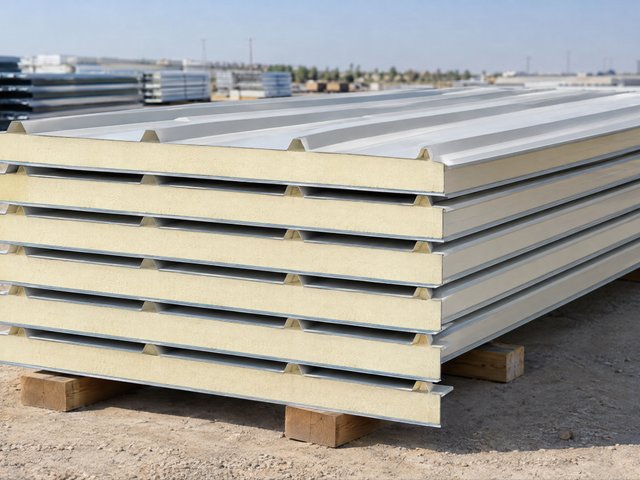
ShownGlass wool roof panels on purlins: yellow glass-fibre core with PU-sealed long edges under a trapezoidal off-white skin

Sandwich Panels · By Core Material

Glass Wool Sandwich Panels

Lightweight non-combustible glass-fibre core panels for roofs and walls needing fire safety and sound absorption.

Group
By Core Material
Market
United Arab Emirates
Supply
Quotation per enquiry

Product overview

Glass Wool Sandwich Panels: overview and uses

A glass wool sandwich panel has a non-combustible glass-fibre core between two steel skins. It is lighter than rock wool, insulates slightly better per millimetre and is often made with PU-sealed edges to keep the joints tight.

Glass wool is spun from molten glass into fine fibres. As an insulation material it is classed A1, non-combustible, under EN 13501-1, and it absorbs sound well. In a sandwich panel it gives a lighter build than rock wool, which helps on long roof spans and on lighter steel frames.

Many glass wool roof panels are produced with polyurethane foam sealing the long edges. The foam strip closes the joint, blocks moisture from reaching the fibres and makes the panel lock tightly, while the glass wool core keeps its non-combustible character. OGB confirms the exact edge detail, thickness and fire documentation per project.

Characteristics

Why Glass Wool Panels works in the UAE

Non-combustible core

Glass wool insulation is classed A1 to EN 13501-1.

Lighter than rock wool

Core density well below rock wool keeps panel weight down on long roof spans.

PU-sealed edges

Foam-sealed joints keep moisture out of the fibres and close the panel tightly.

Build your panel

Choose core, thickness and colour

Pick a combination to see its insulation value, then send it to OGB as a quotation request. Every panel is made to order and cut to your length.

1 · Core
2 · Thickness
3 · Outer colour

Colours shown are the common stock RAL shades; other RAL colours, PVDF coatings and different inner/outer colours are available on request. Screen colours are approximate, so confirm against a physical colour card.

Where glass wool panels are used, and why

Glass wool panels sit between foam panels and rock wool panels. Like rock wool, the core does not burn; like foam, the panel stays light. That combination makes them a practical choice for large roofs and buildings where fire safety is important but the steel frame should stay light.

  1. 01Large-span roofs: factories, logistics warehouses and aircraft or vehicle hangars, where a lighter panel reduces the load on long purlin spans.
  2. 02Sports halls, auditoriums and mosques: the glass fibre absorbs sound, so the inside is quieter and echo from rain and machinery is reduced.
  3. 03Workshops and production halls: noise from machines is kept inside, and the non-combustible core adds a margin of safety.
  4. 04Buildings near hot processes: welding bays, foundries and kitchens where a foam core is not preferred.
  5. 05Wall cladding where the specifier asks for a non-combustible insulation core but rock wool weight is not needed.
Why the PU-sealed edge matters

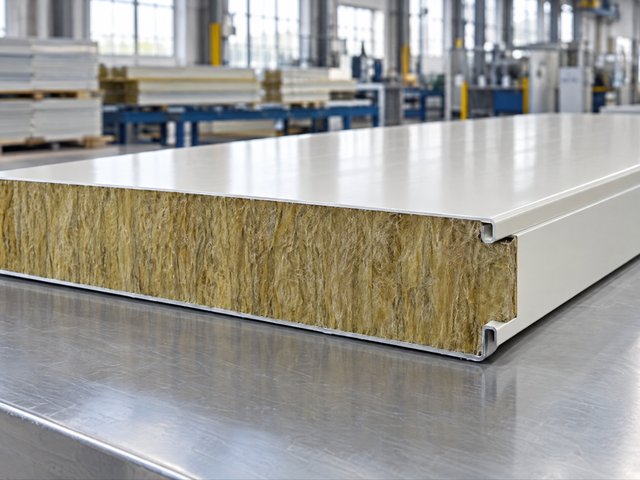
Glass fibre is soft and can take up moisture if its edge is open. On a PU-sealed panel, a strip of polyurethane foam runs along both long edges. It closes the joint between panels, stops humid air and water reaching the fibres, and gives the panel a firm, accurate edge so neighbouring panels lock tightly. The rest of the core stays glass wool, so the panel keeps its non-combustible character.

Glass wool or rock wool: choosing between them

Both are mineral wools and both are non-combustible. The choice is usually about weight, sound and the fire-resistance target.

  1. 01Choose glass wool for lighter panels on long roof spans, and for good sound absorption at a lower weight.
  2. 02Choose rock wool where the project needs a formal fire-resistance rating such as EI 60 or EI 120, or the highest density for sound insulation.
  3. 03For both, ask for the reaction-to-fire certificate of the core and the test report of the complete panel system.

Technical data

Specifications

Share your required size, quantity and finish in the enquiry form and OGB confirms availability in writing.

Enquire about Glass Wool Panels
Glass Wool Sandwich Panels specifications
Core Glass wool (glass fibre); PU-sealed edges on request
Thermal conductivity ≈ 0.040 – 0.042 W/m·K
Reaction to fire (core) A1, non-combustible (EN 13501-1)
Core density ≈ 30 – 75 kg/m³ depending on grade
Panel thickness 50, 75, 100, 150 mm (up to 200 mm on request)
Skins PPGI / PPGL 0.4 – 0.6 mm; roof trapezoidal or wall flat
Cover width ≈ 1,000 mm
Length Cut to order

Testing & standards

How Glass Wool Panels are tested

These are the test methods and standards that specifiers, civil defence and insurers ask about. Ratings belong to a specific tested system, so OGB supplies the certificate that matches your panel, thickness and joint.

EN 14509
European product standard for self-supporting double-skin metal-faced sandwich panels: dimensions, tolerances, strength, thermal and fire declarations.
EN 13501-1
Reaction-to-fire classification (A1, A2, B … F) of the panel or its core.
EN 13501-2 / EN 1364
Fire-resistance rating of a tested wall or roof system, written as EI 30, EI 60, EI 120 (integrity and insulation, in minutes).
ASTM E84 / UL 723
Surface burning characteristics: flame-spread and smoke-developed indices.
FM 4880 / FM 4881
FM Approvals tests for fire performance and for structural and wind-load performance of insulated panel systems.
NFPA 285
Large-scale fire-propagation test for exterior walls that contain combustible components.
ASTM C518
Laboratory measurement of thermal conductivity and R-value of the insulating core.
ASTM E283 / E331
Air leakage and water penetration through the panel joints under pressure.

Questions

Glass Wool Sandwich Panels: common questions

Glass wool or rock wool panel: which should I choose?

Both cores are non-combustible. Choose rock wool where a high fire-resistance rating (EI 60 / EI 120) or the best sound insulation is required. Choose glass wool where you want a lighter, slightly better-insulating non-combustible panel, such as long-span roofs.

Why are the edges sealed with PU?

Glass fibre can absorb moisture at exposed edges. A polyurethane foam strip along the joint seals the edge, keeps the joint tight and stops moisture getting into the core, while the main core stays glass wool.

Why do roof panels cost more than wall panels?

A roof panel has a deep trapezoidal outer skin that uses more steel per square metre and needs a stiffer profile to shed water and carry foot traffic during installation, so the same core thickness costs more on a roof than on a wall.

Free tools · No sign-up

Need quantities for Glass Wool Panels?

Free calculator for sandwich panels, fencing, roofing sheets and steel weight. Change a number and the drawing and quantities update live. No prices, no sign-up.

Request a quotation

Request a quotation for Glass Wool Sandwich Panels

Share your drawings, bill of quantities or a simple list of items. OGB confirms sizes, finishes and availability and returns an itemised quotation.