

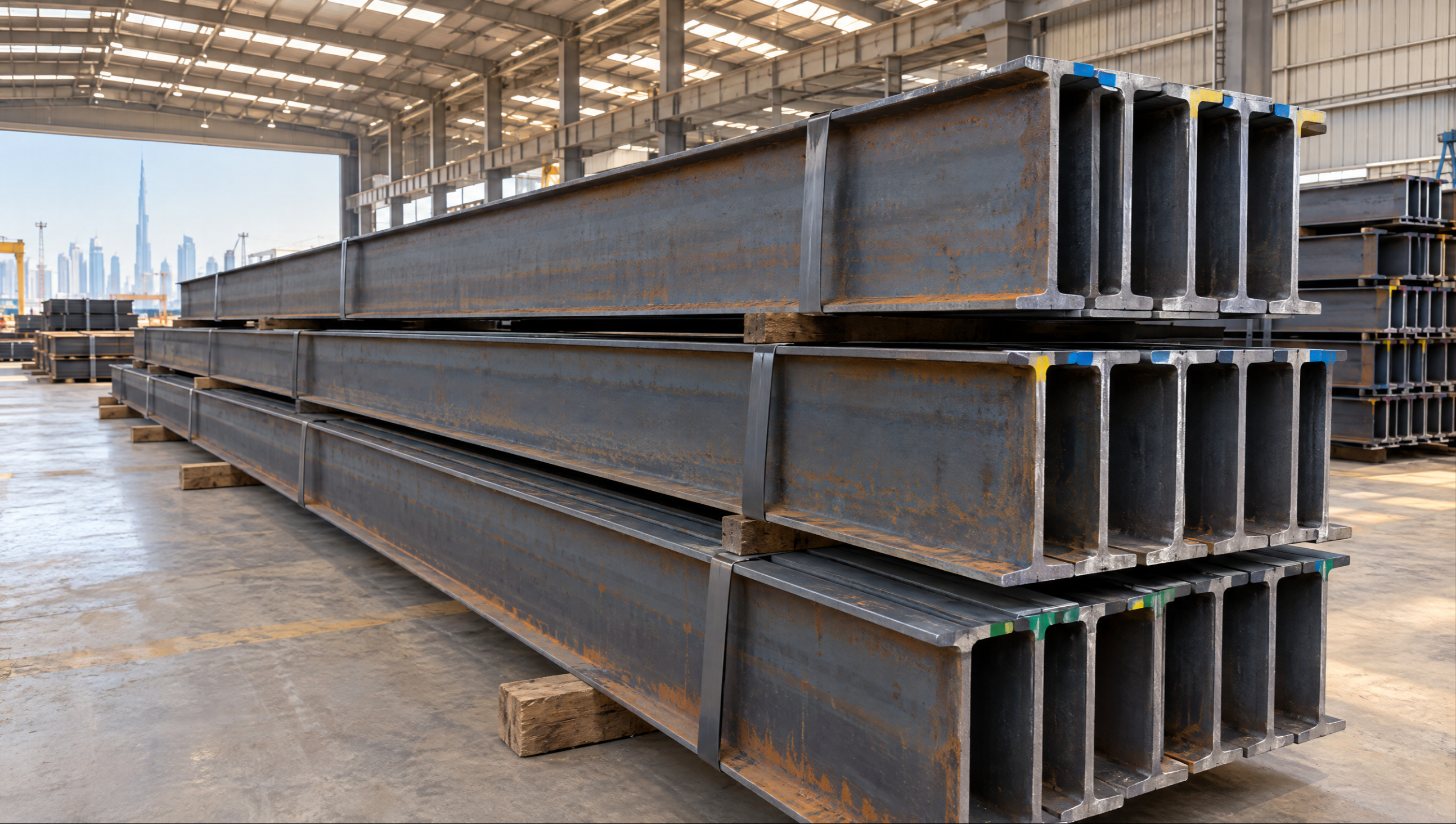
Short answer
Use an I-beam (IPE) where a member mainly bends under load, such as floor and roof beams. Use a hot-rolled U-channel (UPN) for edge members, trimmers, frames and bracing where a flat back is easy to fix to. Use a cold-formed C-channel for light purlins, girts and framing. A structural engineer sets the final size.
The three shapes at a glance
| I-beam (IPE) | U-channel (UPN) | C-channel (cold-formed) | |
|---|---|---|---|
| Shape | Tall and narrow, parallel flanges both sides of the web | Flanges on one side, tapered inner faces | Thin strip bent into a C, often with lips |
| Best at | Bending in one direction | Edge members, frames, fixing to walls | Light loads over short spans |
| Typical use | Floor beams, roof rafters, mezzanine joists | Trimmers, stair stringers, frames, bracing | Roof purlins, wall girts, light framing |
| How it is made | Hot-rolled, EN 10365 dimensions | Hot-rolled, EN 10365 dimensions | Cold roll-formed from black or galvanized strip |
Same depth, different weight
Comparing hot-rolled sections of the same depth shows how the shapes differ. The I-beam puts steel on both sides of the web, the channel only on one.
| Section | Depth | Flange width | Weight |
|---|---|---|---|
| IPE 160 | 160 mm | 82 mm | 15.8 kg/m |
| UPN 160 | 160 mm | 65 mm | 18.8 kg/m |
| IPE 200 | 200 mm | 100 mm | 22.4 kg/m |
| UPN 200 | 200 mm | 75 mm | 25.3 kg/m |
Nominal values from the EN 10365 section tables. Mill tolerances apply.
Checks before you order
- Confirm the section designation and size from the structural drawing (for example IPE 300, UPN 160).
- Confirm the steel grade: S235JR, S275JR or S355JR to EN 10025-2.
- Confirm lengths: 6 m and 12 m are the common stock lengths.
- Ask for mill test certificates (EN 10204 3.1) when the project requires them.
- Use the free steel weight calculator to estimate total tonnage.
Frequently asked questions
What does IPE stand for?
IPE is the European designation for a parallel-flange I-section. The number is the nominal depth in millimetres, so IPE 200 is about 200 mm deep.
What is the difference between UPN and C-channel?
UPN is a hot-rolled channel with thick, tapered inner flanges, used as a structural member. A C-channel is usually cold-formed from thin galvanized strip with lips on the flanges, used for purlins, girts and light framing.
Can a channel replace an I-beam?
Sometimes, for short spans and edge members. Because a channel has flanges on one side only, it can twist under load unless it is restrained, so the structural engineer decides.