

Short answer
As a rule of thumb, use 75 – 100 mm PU / PIR panels for chillers at 0 to +5 °C, 120 – 150 mm for freezers at −18 to −25 °C, and 150 – 200 mm for blast or deep freezers at −30 to −40 °C. Large rooms, frequent door openings and hot plant-room walls can push the choice up one size.
Quick reference table
| Room | Temperature | Panel thickness | Typical goods |
|---|---|---|---|
| Cool / chiller room | 0 to +5 °C | 75 – 100 mm | Fruit, vegetables, dairy, drinks |
| Pharma cold room | +2 to +8 °C | 75 – 100 mm | Medicines and vaccines (to project design) |
| Freezer room | −18 to −25 °C | 120 – 150 mm | Frozen meat, fish, ice cream |
| Blast / deep freezer | −30 to −40 °C | 150 – 200 mm | Fast freezing of fresh meat and seafood |
Ranges agree across several cold room panel manufacturers. The refrigeration designer confirms the final thickness.
Why thickness matters more in the UAE
Heat flows through a panel in proportion to the temperature difference across it. A freezer at −25 °C inside a warehouse that reaches 45 °C in summer has a 70 °C difference across its walls, far more than the same room in a cooler climate. Every extra 25 mm of PU / PIR foam cuts that heat flow noticeably, so the compressor runs less and the room holds temperature during door openings.
Humidity is the second reason. Warm, moist air that leaks into a freezer turns into frost on the evaporator and ice on the floor. Correct thickness keeps the inner face above the dew point of the outside air, which stops condensation on the outer skin.
How to work out the insulation value
The thermal resistance of the core is its thickness divided by its thermal conductivity (R = t / λ). With a PU / PIR core of about λ 0.022 W/m·K:
- 75 mm → R ≈ 3.4 m²·K/W
- 100 mm → R ≈ 4.5 m²·K/W
- 150 mm → R ≈ 6.8 m²·K/W
- 200 mm → R ≈ 9.1 m²·K/W
Checks that can change the answer
- Room size and door traffic: busy dispatch chillers lose more cold through doors than through walls.
- Walls facing a hot plant room, kitchen or the outside sun need the thicker option.
- Freezers below 0 °C need an insulated floor, often with under-floor heating, to stop the ground freezing.
- Ceiling spans: larger rooms hang the ceiling from a steel structure above.
- Approvals: ask for test reports and local authority approval for the panel and its core.
Frequently asked questions
Can I use 100 mm panels for a freezer?
Small freezers at about −18 °C are sometimes built in 100 mm, but 120 – 150 mm is the usual choice in the UAE because of the high outside temperature. Thinner panels raise running costs and the risk of condensation.
Is PIR better than PU for a cold room?
Both have about the same insulation value. PIR has better fire performance, so it is often specified where fire rating matters.
What joint is best for cold room panels?
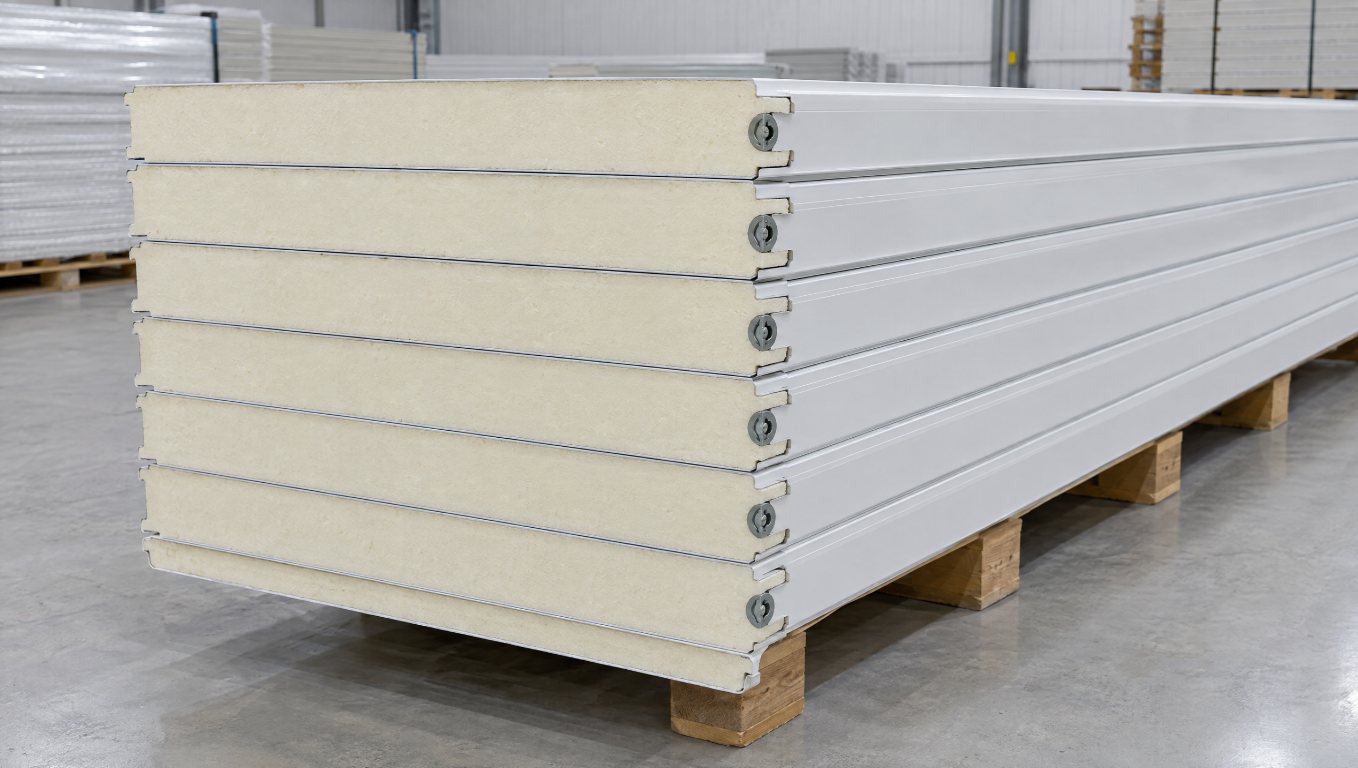
Cam-lock joints pull panels tightly together with a key and are sealed with silicone. They are airtight and can be taken apart if the room is moved.